
SHOULD YOU USE A TWO COLUMN CV IN GERMANY?
Should you use a two column CV when applying for jobs in Germany? It’s an age-old debate and depending on who you talk to, you’ll get wildly different answers. Unfortunately, there is a lot of misinformation out there. No one seems to know what’s what. Some will tell you two-column CVs are fine, others will go on long tangents about how one column CVs are the only way to go.
That’s why we’re here with this helpful Germany career guide. In this career guide, we’ll:
⭐ Understand how common two-column CVs are in Germany.
⭐ Outline the most compelling reason why two column CVs can work in your favour.
⭐ Learn about the misinformation problem.
⭐ Examine the most popular recruiting platforms in Germany, their various features and limitations, and how well two-column CVs render in their systems.
⭐ See which systems are most two-column CV friendly, vs which ones are not.
⭐ Read actual quotes from Germany-based recruiters sharing the real-deal.
⭐ Help you make an informed decision about which format to use and when.
⭐ Provide an FAQ addressing the most frequently asked questions on this topic.
Join Our Growing Community
Stay Ahead of the Game: Get the latest news on immigration, job opportunities, and life in Germany delivered straight to your inbox.
Expert Career Advice: Benefit from my 10 years of experience as a career coach & hiring manager.
Insider Tips & Guides: Access 60+ free guides to living and working in Germany.
Community Events & Networking: Join our events to connect with like-minded professionals & build your network in Berlin.
Authentic Stories: Enjoy a personal touch from me with stories, rants, and reflections that make the newsletter informative and enjoyable.
⭐ Can I just say, even though I live in Munich and am not looking for a job – I LOVE your newsletter. Anyone who is a German expat should sign up for it – a lot of value, humanity, and humor in there. - Eleanor, Munich
⭐ Thank you, Cheryl! Always find your newsletters brilliantly written and full of useful tips and insights! 🙏 - Liudmyla, Germany
⭐ Always short and sweet - if you want a sharp update on Berlin life, this newsletter will help you keep up with the latest topics. - Alexandra, Berlin
⭐ Just wanted to pop in and say your page on LinkedIn, as well as the newsletter, are amazing and provide so much value - and relatable stories. - Arunima, Berlin
⭐ Really, on-point, insightful and helpful company, especially through their weekly newsletters, and covering all things, Berlin, Germany, EU and the world. - Rajiv, Berlin
⭐ Great newsletter with info about what is going on in Berlin, what expats should be aware of, and where to look for a job (list of companies that are hiring right now). - Aga, Berlin
More than 10,000 people in Germany are already in. Don’t miss out on the insights, support, and opportunities that The Berlin Life offers. Subscribe now.

THE TWO COLUMN CV DEBATE IN GERMANY
We’re going to address the debate around one vs two column CV’s in a comprehensive, detailed, and thoughtful way, backed by data and not by opinion. As such, we hope this guide will help you make an informed decision about which CV format to use and when.
We also recommend bookmarking and reading our other CV guides:
⭐ Do You Really Need German CV Photos? The Surprising Truth
Two Column CVs Are Common in Germany
People often wax poetic about one-column CVs and why you should use them. But in Germany, the two column format is pretty commonplace. When you search for German CV templates (Bewerbungsvorlagen) on sites like Lebenslauf.de or Bewerbung.com, most suggested formats are indeed the two-column design.
Two column designs usually have a narrow column for things like contact information, languages, and education and a wider column for things like professional summary, work experience, and skills. It’s a structured design that just works well, but more on that later.
Here’s a rough example of what a two column CV looks like. ⬇️
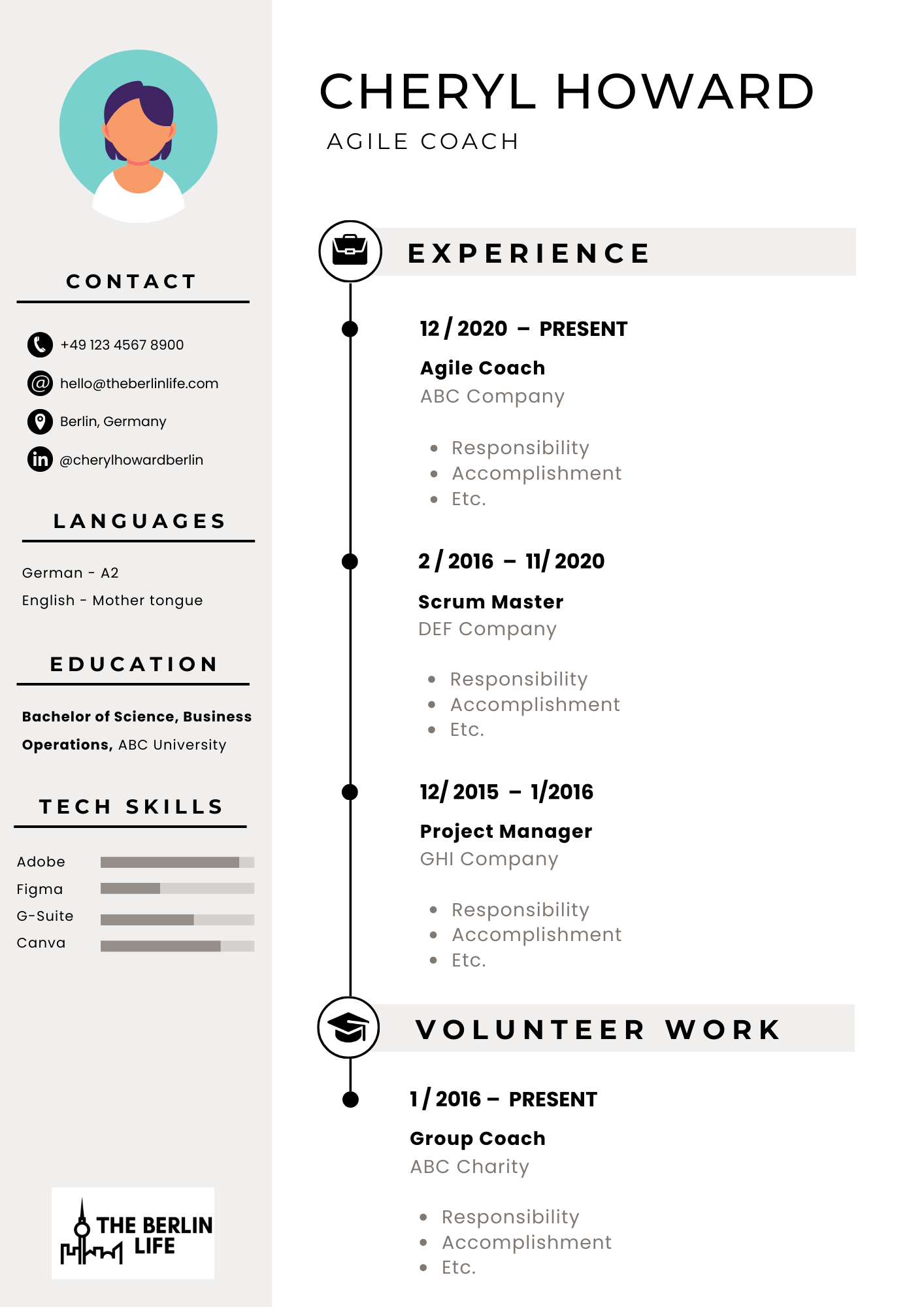
German employers are familiar with the two-column CV design and won’t have issues. Generally speaking, they actually tend to prefer a clean, neatly designed layout that the two column layout offers.
While it’s true that some applicant tracking systems (ATS’) have difficulty parsing data a two-column CV, it’s very much dependent on the features and limitations of the recruiting platform being used and more importantly, how the platform is actually being used by the recruiting team.
The reality is that most German companies do manual screening of CVs and don’t rely on an ATS to sort and recommend candidates. We all know Germany is behind the times technically speaking, and the trend of a human being reviewing your application with their own eyes is the norm, not the exception.
Therefore, the risk of missing CV data and not getting recommended by an ATS is incredibly low.
Why a Two Column CV in Germany is a Good Idea
I personally recommend using a two-column CV format. Different coaches and recruiters have varying opinions, but let me share why I think this is the best format.
It ensures that the relevant information on the first page of your CV gets into the eyes of German recruiters and hiring managers right away. There are certain pieces of information they want to know at a quick glance, like education, languages, visa status, and skills. They run through a quick checklist in their head, so it’s essential to have that information at the forefront of your CV, not buried on page two. This means first page real estate is everything.
It’s important to understand there is one primary purpose of a CV: To quickly and easily let companies know how you can help them solve their problems. You need to make recruiters and hiring managers want to meet you after only a brief read. Most people don’t have the time or the willingness to scan through long CVs or work at having to find what they want to know.
Studies say German recruiters and hiring managers only look at CVs for less than a minute, so hooking them quickly is crucial. Multiple eye-tracking studies (including this one from StepStone), show that decision-makers skim CVs first, then only deep-dive into those that pass the instant relevance test.
This is why two column CVs work so well. The narrow column becomes your “hook zone” with a condensed list of high-value facts (languages, certifications, degrees, etc. ) that lets recruiters verify fit instantly. When a recruiter opens a CV and sees everything they need in one glance, their brain shifts from “Should I read this?” to “Okay, this person is good. Let’s see more.”
At the end of the day, a German CV should be structured for speed of recognition, not chronological storytelling. If key details don’t appear at a glance, your application risks being skipped even before a recruiter gives it a full read.
Beware of Misinformation About ATS Usaage
By now, you’ve already learned that two-column CVs are common in Germany and why they just work. But why do so many people tell you differently? Most will cite the problem of ATS’ not rendering two column CV’s properly.
When you upload your CV into an HR system, the file is usually passed along, “as is”. In fact, all recruiting platforms we looked are confirmed to keep file integrity intact, which is fine for companies doing manual CV reviews.
It gets more complicated though. Some systems will also parse your CV data from the uploaded file and map it to a searchable database. A human can then quickly search for certain keywords and get related candidate recommendations. Some systems even have algorithmic candidate recommendations based on pre-set filters.
The logic is that if you upload a two-column CV, not all the data may make it over and will be missed later when searched. So all that time you spent including certain information on your CV could get completed removed during the upload process. In some cases, the two column file structure seems to “break the brain” of a system when imported.
While this concern is valid, the risk of this happening in Germany is low for the previously cited reasons. Germany’s not that advanced and in most companies, it’s a human who’s going to eyeball your CV. Not only that, some HR systems also have advanced search features that read text in PDF’s – making this a moot point.
Despite this, you’ll see a lot of impassioned speeches saying one-column CVs are the only way to go. Beware of disinformation and look at who’s delivering the message.
Look deeper and determine if they are a seasoned recruiter or hiring manager, who has experience in the German job market and working with different systems. Are they just someone who’s pretending to be an expert when they are not? Are they able to accurately talk about the technical features and limitations of various recruiting systems? Can they cite data to support their arguments?
If you encounter someone who doesn’t seem to know what they’re talking about, send them our guide. 😉
Popular HR Platform Features and Limitations Compared
We’ve featured some of the most widely used HR platforms in Germany and highlighted their features and limitations with two-column CV files that are submitted as a PDF.
Note: This data was generated by ChatGPT using the Deep Research function. Source links are listed at the bottom of this guide.
| Platform | Visual Display (2-col PDF) | Automatic Parsing | Filter/Search Utility | Recruiter Experience | Overall Recommendation |
|---|---|---|---|---|---|
| Notion | ✅ Renders exactly as designed | ❌ None (PDF treated as attachment) | ❌ PDF text not indexed/searchable | Manual, opens PDF and reads | Two-column OK for Notion pages; keep a one-column version handy if they export to an ATS later. |
| Greenhouse | ✅ Preserved | ⚠️ No scoring; basic parsing/indexing can miss side-column order | ⚠️ Keyword search works but may skip sidebar terms | Human review + search | Two-column acceptable, but one-column safer to ensure keywords are found. |
| Workday | ✅ Preserved | ❌ Common failures with columns/tables | ❌ Inaccurate parsed fields hurt filters | Often triages via parsed profile first | Use one-column. Avoid tables/graphics. |
| JOIN.com | ✅ Preserved | ❌ Parsing/ranking can misread columns | ⚠️ Ranking/search rely on parsed data | Parsed profile first; PDF on click | Prefer one-column. If using two-column, repeat key skills in main flow and fill all form fields. |
| Ashby | ✅ Preserved | ⚠️ Built-in parsing; AI criteria may miss sidebar keywords | ⚠️ AI/search weaker if keywords aren’t in main flow | PDF viewed, but AI/filters influence triage | Prefer one-column. If two-column, keep essentials (contact, skills, titles) in primary column. |
| Personio | ✅ Preserved | ❌ Textkernel parsing fragile with columns/tables | ❌ Filters/search depend on parsed fields | Parsed data used for quick screening | Strongly use one-column. Keep layout simple and linear. |
ATS Risk Assessment
HR platforms, listed from least risky to most risky for being able to parse information in a two-column CV PDF file.
| Rank | Platform | Forgiveness Level for Two-Column CV | Why |
|---|---|---|---|
| 1 | Notion | High | Always preserves layout; no parsing means nothing to “break” — but also no keyword search, so entirely human-read. Safe if recruiter reads every CV manually. |
| 2 | Greenhouse | Moderate–High | Displays perfectly; keyword search works. Parsing not used for scoring, but side-column keywords might still be missed in search. |
| 3 | Ashby | Moderate | Preserves visuals; AI and parsing can work, but side-column info may not be factored into AI match score. |
| 4 | JOIN.com | Moderate–Low | Displays fine; automated ranking relies on parsing, which can misread or skip side-column content. |
| 5 | Personio | Low | Uses parsing heavily for profiles/filters; two-column layouts risk missing critical info like contact details or skills. |
| 6 | Workday | Very Low | Parsing and autofill known to fail with columns; can result in broken or incomplete application data. |
Actual Quotes from Germany Based Recruiters
🚧 Coming soon.
Make an Informed Decision About Two Column CV Use in Germany
TL;DR: Two column CVs are most likely fine, as Germany is that old school and companies are manually reviewing candidate’s CVs.
If you still feel the need to be cautious, do this:
⭐ Keep two versions of your CV. A one column ATS-friendly version and a two column standard German version.
💫 Use the one column CV when applying to big international companies using global ATS platforms. Upload an ATS-friendly, single-column PDF (no tables/columns/text in headers/footers) whenever you’re applying via Workday, JOIN, or Ashby. This maximizes parse quality and filter hits.
💫 Keep your beautifully designed two-column PDF for direct emails, referrals, portfolio links, or when you know it’s a manual Notion/Greenhouse workflow. It’s perfect for German companies and any role where a human will review your application first. This version makes your key skills, languages, and education instantly visible.
⭐ Switch between these depending on the company’s size, industry, and hiring process. This way, you get the best of both worlds, a strong first impression with recruiters and a CV that plays nicely with applicant tracking systems.
When creating your two-column CV in Germany, make sure you do these things:
⭐ Keep all must-find info in the main reading flow (name, contact, titles, employers, skills).
⭐ Avoid tables and use simple headings & bulleted lists.
⭐ Export a real text PDF (selectable text, tagged/logical order).
⭐ Self-test parsing by doing a copy–paste of your whole PDF into a plain-text editor. If the order is garbled, an ATS will see a mess.
⭐ Mirror key terms in form fields (skills/tech stack) whenever the application form offers them. Personio/Greenhouse searches rely on those fields when parsing fails.
FAQ
These are some other commonly asked questions about two column CVs in Germany.
What specific information should go in the left column of a German two-column CV?
The left column should contain quick-scan information: contact details, languages with proficiency levels, education with grades, key certifications, technical skills, and visa status for internationals. This “hook zone” allows recruiters to verify basic requirements within seconds. Keep entries concise using bullet points rather than paragraphs for maximum scanability.
How wide should each column be in a two-column German CV layout?
Optimal ratio is 30:70 or 35:65 (left:right columns). The narrow left column (6-8cm) provides enough space for essential information without cramping, while the wider right column (12-14cm) accommodates detailed work experience descriptions. Avoid 50:50 splits as they create reading confusion and waste space for detailed content.
How do you handle contact information in a two-column CV format?
Place contact information prominently at the top of the left column or in a header spanning both columns. Include: full name, professional email, phone number with country code, LinkedIn profile, and city of residence. Avoid photos unless specifically requested, and never include personal details like marital status or religion as they’re not relevant for German applications.
How should tech professionals structure their two-column CV for German companies?
Tech CVs benefit greatly from two-column format: place programming languages, frameworks, and certifications in the left column for quick scanning. Right column should highlight specific projects, technologies used, and measurable outcomes. Include GitHub links and technical achievements prominently. German tech companies particularly value seeing technology stacks upfront.
What file format should you use for two-column CVs in Germany?
Always submit PDFs to preserve formatting across different devices and software. Ensure text is selectable (not embedded as images) for ATS compatibility. Name your file professionally: “Lastname_Firstname_CV_2025.pdf”. Avoid Word documents as they can display differently on various systems and lose formatting integrity.
How do you ensure your two-column CV is ATS-compatible?
Test compatibility by copying your entire PDF content into a plain text editor – if the order is logical, most ATS systems will read it correctly. Use simple bullet points, avoid text boxes or graphics overlaying text, and ensure proper reading order (left column first, then right). Include a linear version for companies known to use strict ATS filtering.
What common formatting mistakes ruin two-column CVs in German applications?
Major mistakes include: using tables for layout (confuses ATS systems), placing critical information in headers/footers (often ignored by parsing), using text boxes overlapping content, inconsistent spacing between sections, and making font sizes too small in the narrow column. Always test print your CV to ensure readability.
How do you handle page breaks in multi-page two-column CVs?
Ensure page breaks don’t split related content awkwardly. Plan your layout so each page feels complete – avoid orphaned entries at the bottom. If your left column ends mid-page, consider adjusting content distribution or extending it with relevant additional skills or certifications to balance the visual layout.
How should non-EU citizens highlight visa status in two-column CVs?
Include visa status prominently in the left column, clearly stating your current authorization (e.g., “EU Blue Card,” “Permanent Residency,” “Work Authorization Available”). This immediately addresses a key concern for German employers. If you need sponsorship, be upfront about it rather than hiding this information, as transparency builds trust.
How do you address language skills in a two-column CV for German jobs?
Use the European Framework levels (A1-C2) for language proficiency in the left column. Be specific: “German: B2 (Business Fluent)” or “English: C2 (Native).” Include relevant language certifications. For international roles, emphasize your multilingual abilities as a key differentiator, especially if you can serve specific markets.
What role do LinkedIn profiles play in relation to CV format choice in Germany?
Your LinkedIn profile should complement, not replace, your CV strategy. German companies still heavily rely on formal CV submissions. Ensure consistency between your LinkedIn and CV content. Many German recruiters use LinkedIn for initial sourcing but require formal CVs for official application processes, making professional CV formatting crucial regardless of LinkedIn presence.
Source Links
⭐ Workday: Workday Community: Resume parsing issues (login required) // Recruiter Forums discussing Workday parsing limitations
⭐ JOIN: JOIN Help Center: How CV parsing works // JOIN Blog: How our ATS processes applications
⭐ Personio: Personio Support: CV parsing for candidate profiles // Textkernel Blog: Improving extraction from Column Resumes
⭐ Notion: Notion Help: File uploads // Notion Community: Search limitations in embedded PDFs
⭐ Greenhouse: Greenhouse Support: Unsuccessful resume parse // Greenhouse Recruiting: How resume parsing works
Now that you understand the truth about two column CV in Germany acceptance, you can move forward with confidence knowing you’re making an informed decision.
RELATED CONTENT
Does networking in Germany really get you a job?
Networking in Germany is one part of a job search, not all of it. How to network in Germany while still applying online, from a hiring manager.
Avoiding Embarrassing German Interview Mistakes: Dos and Don’ts
Ace your next interview by avoiding these common German interview mistakes. Learn the dos and don’ts to help you avoid embarrassing slip-ups.
Companies In Berlin Hiring Right Now
Are you looking for a job in Berlin, Germany? Then check out this ever-growing list of 400+ companies in Berlin that are hiring right now.

Cheryl Howard, Founder @ The Berlin Life
Hi, I’m Cheryl. My mission is to help you move to Berlin and find work.
A Canadian in Berlin for 10+ years, I have the unique experience of moving to Berlin – not once, but twice. During my time in Berlin, I’ve had five different visas and worked as both a freelancer and a permanent employee for numerous Berlin companies. I even managed to find a new job during the pandemic and again in 2023, during Germany’s recession and massive layoffs in tech.
My day job has involved work as a hiring manager, overseeing the recruitment of countless people, as well as a team coach helping teams and individuals work better and find happiness in their careers. Through my side projects, I’ve also shared my personal experiences by publishing a series of helpful blog posts, creating a thriving community of job seekers, and hosting events to help people find work in Berlin. In 2021, I decided to put my coaching and recruiting talents to use by creating The Berlin Life, bringing my existing content and community together in one spot.
The combination of my personal and professional experience means I know exactly what it takes to move to Berlin and find work.