CHANGING EMPLOYERS IN GERMANY … CAN IT RUIN ME?
Something that’s universally sad but true is that companies tend to look unfavourably at candidates who’ve changed employers multiple times in their career. They automatically jump to the conclusion that this behaviour somehow reflects poorly on the prospective employee.
Recruiters and hiring managers may incorrectly perceive there must be something wrong with the applicant and assume the worst. That you’re a low performer, that you possess toxic traits, or that you’re a “disloyal” employee always looking for the next best thing (as if that’s bad). Without ever acknowledging that you’re potentially well suited to the job or even inviting you to an interview to get to know you, it’s possible a recruiter or hiring manager will reject your application completely.
Then there’s Germany, where things just hit differently. Adding photos to a CV is commonplace, with recruiters insisting they can tell so much about you from your photo. Without a photo, some won’t even give you a chance. I never knew that glancing at someone’s photo would allow you to accurately access how talented or qualified they are. 🤔
Other insane practices, like adding personal information including marital status and the number of children you have is another one that boggles the mind. While many of these practices are fading out, there are lingering employment practices in Germany that will surprise newbies to the country.
Depending on the industry, company, and role (there are always exceptions), it’s not uncommon for people in Germany to have long tenures with their companies. As such, employers can be extremely suspicious of candidates who’ve moved around a lot. Those career movements can be factored into the decision about whether to even interview you, never mind hire you.
These negative biases can be extremely hard to overcome when changing employers in Germany. That’s why we created this guide to help you out. In this Germany Life guide, we’ll cover:
⭐ The factors that contribute to frequent job changes
⭐ Why people change jobs in Germany
⭐ The ups and downs of my career as a foreigner in Germany
⭐ How changing employers in Germany is normal, especially in the current economy
⭐ A brief explanation about why the biases still exist
⭐ How to tell your story and take control of narrative (in job applications and interviews)
⭐ A final conclusion on whether or not changing jobs in Germany is really a good idea
Join Our Growing Community
Stay Ahead of the Game: Get the latest news on immigration, job opportunities, and life in Germany delivered straight to your inbox.
Expert Career Advice: Benefit from my 10 years of experience as a career coach & hiring manager.
Insider Tips & Guides: Access 60+ free guides to living and working in Germany.
Community Events & Networking: Join our events to connect with like-minded professionals & build your network in Berlin.
Authentic Stories: Enjoy a personal touch from me with stories, rants, and reflections that make the newsletter informative and enjoyable.
⭐ Can I just say, even though I live in Munich and am not looking for a job – I LOVE your newsletter. Anyone who is a German expat should sign up for it – a lot of value, humanity, and humor in there. - Eleanor, Munich
⭐ Thank you, Cheryl! Always find your newsletters brilliantly written and full of useful tips and insights! 🙏 - Liudmyla, Germany
⭐ Always short and sweet - if you want a sharp update on Berlin life, this newsletter will help you keep up with the latest topics. - Alexandra, Berlin
⭐ Just wanted to pop in and say your page on LinkedIn, as well as the newsletter, are amazing and provide so much value - and relatable stories. - Arunima, Berlin
⭐ Really, on-point, insightful and helpful company, especially through their weekly newsletters, and covering all things, Berlin, Germany, EU and the world. - Rajiv, Berlin
⭐ Great newsletter with info about what is going on in Berlin, what expats should be aware of, and where to look for a job (list of companies that are hiring right now). - Aga, Berlin
More than 10,000 people in Germany are already in. Don’t miss out on the insights, support, and opportunities that The Berlin Life offers. Subscribe now.

A DEEP DIVE INTO CHANGING EMPLOYERS IN GERMANY
Let’s tackle the topic head on with this career guide about changing employers in Germany.
The TL;DR: Changing Employers in Germany
What this guide offers: Practical strategies for navigating Germany’s skeptical attitude toward frequent job changes, including how to address bias in applications and interviews.
Why frequent job changes happen:
⭐ 90% of startups fail – layoffs and closures are common, especially in Berlin’s startup scene
⭐ German economy stagnation causing unprecedented downsizing even at stable companies
⭐ Foreign workers face barriers: language requirements, credential recognition, discrimination, pay gaps
⭐ Toxic management, lack of growth opportunities, better compensation elsewhere
Germany’s outdated perception:
⭐ Long company tenure still valued despite modern job market realities
⭐ Frequent moves wrongly seen as “red flags” or disloyalty
⭐ Bias exists even when changes result from layoffs, not performance issues
How to overcome the bias:
⭐ CV strategy: Omit very short stints or unrelated roles that don’t fit your career narrative
⭐ Cover letter: Address it head-on with brief, factual explanation if needed
⭐ Interviews: Prepare 30-second neutral/positive explanations for each move
⭐ Frame layoffs honestly: “Company experienced financial difficulties during restructuring”
⭐ Frame toxic situations neutrally: “Opportunity wasn’t what I expected, sought better fit”
⭐ Frame career moves positively: “Dream opportunity aligned with my long-term goals”
Legal protections:
⭐ Probation period: 2 weeks notice (typically 6 months)
⭐ Permanent roles: 4 weeks notice to 15th or month-end (senior roles 3-6 months)
⭐ Severance packages (Abfindung) often substantial if laid off
⭐ Wait for layoff vs. quitting: Immediate unemployment benefits vs. 12-week waiting period
Visa considerations:
⭐ EU Blue Card: Free to change after 2 years, need approval before
⭐ General work visa: Requires Federal Employment Agency approval
⭐ Start process before leaving current job to avoid complications
Bottom line: Changing employers in Germany is normal and doesn’t reflect poorly on you. Good companies understand modern job market realities. If you’re frequently moving due to layoffs, discrimination, or legitimate career growth, own your story confidently and find employers who value what you bring.
1) Common Reasons People Change Jobs
People change jobs for various reasons. These are the most universally common ones:
⭐ Companies declare bankruptcy, or need to scale down operations for financial reasons, resulting in layoffs. In environments where job security is at risk, employees will also seek out new opportunities on their own – this is why I left my last job, as everyone knew layoffs were on the horizon. I also knew organizational coaches were a luxury and being the last coach hired into the company, I was most at risk. So I took fate into my own hands and found a new job in Berlin. When asked during interviews why I was leaving my current job, I was able to easily explain my situation. I was always meant with total and complete understanding.
⭐ Another good reason for changing jobs is due to poor management. This report out of the UK shows how major a role mismanagement plays into employees leaving an organization. It could be bigger picture things, like inexperienced founders running the company into the ground or failing to keep up product innovation. Most often it comes down to a person’s direct manager. Bad managers abound and could exhibit toxic behaviours, like micro-management, forcing unpaid overtime, never checking in, spreading gossip, bullying, gaslighting, favouritism, and more. I’m sure we’ve all had a bad manager at some point during our careers and can recall the nightmares.
⭐ Managers and HR folks will often go on and on about how salary isn’t the only thing that motivates employees to stay on the job. While there’s some truth to this, I also call complete and utter bullshit. Of course there are factors beyond money (ability to work from home, comprehensive benefits, bonuses, a cool team, a life-changing product etc.), but those are all secondary to making bank. Free beers on Friday night don’t pay the rent! Many employees simply leave because they’re able to get way more money somewhere else at a level they would never be able to get with their current companies. Although 2025 trends have revealed a worrying new development; things are levelling off and switching jobs may not always mean a salary bump. It truly is an employer’s market right now.
⭐ Last but not least, people quit their jobs when they feel there is a lack of career growth and other opportunities. They may see no clear path for moving up organizational ranks, may not feel challenged by their work or peers, don’t have a competent mentor to learn from/ grow with, or don’t foresee an exciting future for their company.
2) Why People Change Jobs in Germany
There are even more reasons people leave their jobs that are more Germany specific:
⭐ The path to career success in Germany is much more difficult and time consuming for foreigners than locals. Barriers include German language fluency, having your qualifcations recognized, additional schooling, and more. It’s not that those barriers can’t be overcome, but the path to success isn’t as straight-forward as elsewhere.
⭐ The looming elephant in the room is blatant racism and discrimination that foreigners experience in the workplace and in their personal lives. The alarming rise of the far-right in Germany contributes to people’s fears and results in them leaving their job, or even the country.
⭐ Foreigners in Germany are often paid less and don’t have equal access to opportunity. If an employee finds a comparable opportunity for more money from a more equitable employer in Germany, they’ll leave sooner than later.
Check out these academic papers that dive deeper into the complexities of these issues: The Immigrant Wage Gap in Germany and Immigrants’ recruitment chances in the German labor market: Evidence from large-scale survey experiments.
It’s important to note these factors often interconnect. Employee turnover could result from a combination of these factors.
3) My Employment Story in Germany
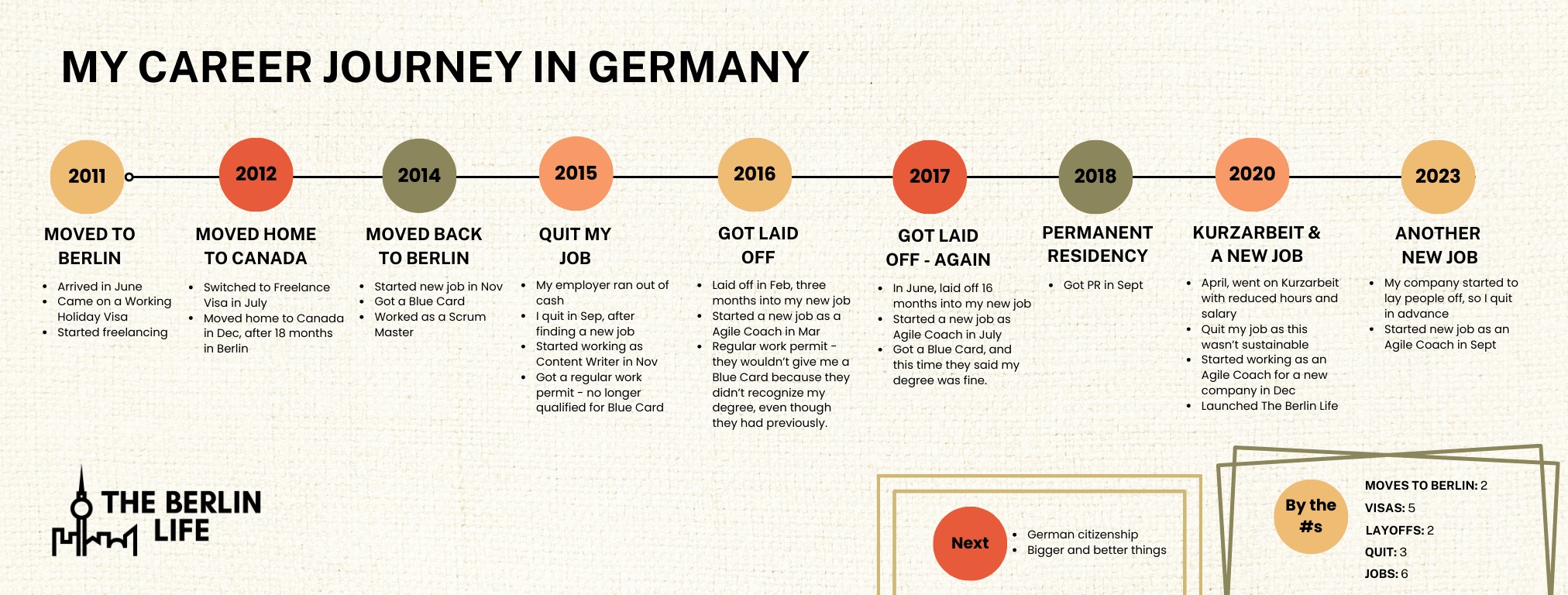
I’ll be honest. My first few years in Germany were rough. I lost my job several times and each time that happened, I lost a little bit of myself. It even became a long-running joke with friends about how I was always looking for a new job. While I always managed to secure a new gig, it didn’t stop me from experiencing severe anxiety and depression. My confidence levels plummetted too.
What happened exactlty? Let me tell you.
⭐ I moved back to Berlin in November 2014, working for a small startup as a scrum master.
⭐ After 6 months, the company tanked financially and I was forced to seek new employment elsewhere.
⭐ By November 2015, I started a new job where I tried out a new career as a marketing content writer.
⭐ In January 2016, my entire team was laid off as part of a large-scale downscaling exercise and I found myself back in the job-seeking boat.
⭐ March 2016 rolled around and I started another job as a scrum master.
⭐ Managing to stay in one place for a while, my company started laying people for financial reasons and in the spring of 2017, I found myself looking for work … again.
⭐ By July 2017, I started my next gig as an Agile Coach.
⭐ I stayed with this company for three+ years, but when their business was adversely impacted by the pandemic, I sought out a new job in the summer of 2020.
⭐ Fast forward to December 2020, I took on a new position as a team coach.
⭐ When financial difficulties struck my place of work in Jan 2023, I didn’t wait to be laid off. I went on the job search once more.
⭐ In September 2023, I started a new job as senior agile coach and I’m still with the company – although, now working as a product owner.
It’s not an understatement to say that I’ve moved around a lot since I moved to Germany. And for sure, my career movements have been subjected to a fair amount of scrutiny while I’ve been looking for work.
Without knowing my story, many people have jumped to unfairly false and baseless conclusions about my character and capability. My career trajectory is somehow a “red flag.”
4) Let’s Normalize Changing Employers in Germany
If you read through the series of events depicted in my career journey above, it’s fairly obvious that I was never once fired and I didn’t change jobs because I was relentlessly ambitious and opportunistic.
The simple explanation is that when I first moved here, I worked for startups where restructuring and business closures are normal occurrences. In fact, 90% of all startups are doomed to fail.
In Berlin, the so called startup capital, some locals will say you’re not a “real Berliner” unless you’ve been made redundant at least one or more times. From talking with countless Berliners over the years, I know that my story is not unique.
Nowadays, even the most financially stable companies are downsizing. The German economy is stagnant right now for various reasons and layoffs are more commonplace than ever before in certain professions or industries.
Beyond that, the reality is that people don’t stay in one company for their entire life, even in Germany. It’s normal to move around, whether you get laid off or are simply seek out a new opportunity.
Furthermore, no one is indebted to a company, like ever. Loyalty to a financial entity is an outdated notion reserved for boomers. You work for an organization because they pay you to do something, nothing more. It’s a commercial transaction and ultimately, you’re just a number. If the situation calls for it, they won’t hesitate to lay you off, stop giving out raises, and more.
5) Frequently Changing Jobs May Still Be Held Against You
Yet, despite our new reality, time and time again, I’ve had to defend myself. When I’ve played the role of hiring manager, I’ve had to defend candidate choices for this reason as well.
During these moments, I confidently share my story, and factually recount the events as they occurred. When people actually listen, they quickly understand that frequent career movement is an ugly reality for many job seekers.
But there isn’t always somewhere there who can provide that prospectvive and changing employers in Germany can truly impact your job search.
6) How You Can Overcome The Bias
Good companies won’t judge you for frequently changing employers in Germany but in any case, there are things you can proactively do to minimize any potential bias.
For job applications:
⭐ You don’t have to highlight every single place you’ve ever worked on your CV. If there were jobs where you only stayed for a brief amount of time or you worked in an unrelated job that doesn’t fit into your overall career profile, leave it out completely. For example, I don’t include the time I worked as a marketing content writer on my current CV, which is way more scrum master and coach focused.
⭐It might be unconventional but you can address the issue head-on in your cover letter by providing a short, fact-based explanation for your career movements.
I recommend reading my detailed guides about how to write a German CV and another on how to write a German cover letter for even more information.
For interviews:
⭐ Be confident and prepared to speak about why you left the company. You can write down notes and practice your answers beforehand.
⭐ Keep your explanation brief and to the point. You don’t need to get into too many details or answer uncomfortable questions.
⭐ Stick to the facts and don’t exaggerate.
⭐ Even if you had a negative experience working somewhere, find a way to portray it in a positive or at least, a neutral light:
💫 Leaving a company with precarious finances: I loved my time at <company name>, but sadly they experienced financial difficulties and I was let go during restructuring efforts. I still keep in contact with my former manager and team.
💫 Leaving a job because of a toxic workplace: I spent a year at <company name> but found the place wasn’t what I expected. I appreciated my time there and learned a lot, but decided on seeking out new opportunities.
💫Leaving for career growth or more money: I enjoyed my time at <company name> but when I saw an opportunity at <company name>, I knew I had to apply as it was a dream place for me to work. I still maintain good relations with my former employer and would possibly work for them again in the future.
If you need interview tips, check out our detailed guide to job interviews in Germany.
7) Is Changing Employers In Germany A Good Idea?
The brutal truth is that changing jobs frequently could very well impact your job search efforts. No matter how much we all agree on how stupid this is! Whether you’re laid off, quit because of a toxic workplace, or simply found a new opportunity elsewhere, don’t take it personally if you find yourself rejected, and for sure, don’t let it hold you back from going somewhere new.
Stay strong and keep up the job search and you’ll eventually land at a good company. 💪
FAQ
Here are some further commonly asked questions when changing employers in Germany.
How long should I stay at a job in Germany before changing employers?
There’s no strict minimum, but staying at least 12-18 months demonstrates stability to future employers. However, if you’re in a toxic environment or facing redundancy, don’t feel obligated to stay longer. German labor law protects employees during probationary periods (typically 6 months), after which you’ll have stronger job security and notice period requirements.
How do I explain employment gaps when changing jobs frequently in Germany?
Be honest about gaps but frame them positively. Common acceptable reasons include: professional development courses, family obligations, health recovery, or strategic job searching. German employers generally respect work-life balance, so taking time for personal reasons is more accepted than in other countries.
Should I negotiate a higher salary when changing employers in Germany?
Yes, job changes are often the best opportunity for salary increases in Germany. Research industry standards using platforms like Xing, Kununu, or Glassdoor Germany. Be prepared to justify your request with specific achievements and market data. Many German companies have structured pay scales, so understand their framework before negotiating.
What notice period do I need to give when changing employers in Germany?
During probationary periods (Probezeit), you typically need 2 weeks’ notice. For permanent employees, it’s usually 4 weeks to the 15th or end of the month. Senior positions may require 3-6 months’ notice. Check your employment contract (Arbeitsvertrag) for specific terms, as they can vary.
Can I change employers while on a work visa in Germany?
Yes, but the process depends on your visa type. EU Blue Card holders can change employers after 2 years without approval, or before with permission. General work visa holders need approval from the Federal Employment Agency (Bundesagentur für Arbeit). Start the process before leaving your current job to avoid complications.
Is it better to quit or wait to be laid off in Germany?
If layoffs are imminent, it’s often better to wait. German severance packages (Abfindung) can be substantial, and you’ll be eligible for unemployment benefits (Arbeitslosengeld) immediately. If you quit voluntarily, you may face a 12-week waiting period for benefits. However, if you have another job lined up, quitting allows you to control the timing.
What should I do if I'm facing discrimination during the job search due to frequent employer changes?
Document any instances of discrimination and consider contacting:
⭐ Antidiskriminierungsstelle des Bundes: Federal Anti-Discrimination Agency
⭐ Local employment agencies: They can provide guidance and support
⭐ Legal advice: Employment lawyers (Arbeitsrechtler) can advise on your rights
⭐ Professional associations: Many offer support for members facing discrimination
Remember, legitimate business reasons for job changes should not be held against you, and good employers will understand your situation when properly explained.
Frequently changing employers in Germany is normal and doesn’t reflect poorly on you. Don’t let anyone tell you otherwise!
RELATED CONTENT
Does networking in Germany really get you a job?
Networking in Germany is one part of a job search, not all of it. How to network in Germany while still applying online, from a hiring manager.
Avoiding Embarrassing German Interview Mistakes: Dos and Don’ts
Ace your next interview by avoiding these common German interview mistakes. Learn the dos and don’ts to help you avoid embarrassing slip-ups.
Companies In Berlin Hiring Right Now
Are you looking for a job in Berlin, Germany? Then check out this ever-growing list of 400+ companies in Berlin that are hiring right now.

Cheryl Howard, Founder of The Berlin Life
A Canadian in Berlin since 2011, I’m a career coach who’s reviewed hundreds of job applications, found work during both the pandemic and the 2023 tech layoffs, and moved to Berlin not once, but twice. Through my 60+ guides, weekly newsletter, coaching, and community events, I help people move to Germany and find work.