
HOW TO FIND A JOB IN BERLIN
So you’re a newbie Berliner, or maybe you’re an aspiring Berliner. Whatever your situation, you’re looking for a job in Berlin and are wondering exactly how people find work in the German capital. You’ve probably heard the expression, “Berlin is poor but sexy.” While I hate the reference as it’s too overused, it has a certain truth. Berlin is known to be a creative mecca for artists and a technology hub for startups. However, it’s never been a place booming with high-paying jobs that you might find elsewhere, like in the automobile city of Stuttgart or the financial hub of Frankfurt. As of March 2024, unemployment hovered around 9.6% in Berlin, while the rest of Germany remained at a rate of about 5.7%.
While finding work in Berlin isn’t impossible, it isn’t easy either. Numerous factors impact your ability to find a job in Berlin, such as your German language skills, level of education, whether or not your skills are in demand, if you need a visa, and more. Then, there are racial, gender, age, and other biases that can hinder you during the recruitment process. The German economy hasn’t been immune to major world events either, with the war in Ukraine causing living standards in Germany to decline in 2023 – more than any other year since 1950. Taking all of these things into consideration, it certainly can feel like the odds of finding a job in Berlin are somewhat stacked against you.
Recommended reading: My guide about the reality of finding work in Berlin. We outline the barriers to finding employment in Berlin, as well as provide several practical suggestions about how to overcome those barriers.
In this Berlin Life guide, you can expect:
⭐ 15 pro tips from an actual expert (that’s me!), an experienced career coach and hiring manager who has not only helped loads of people find jobs in Berlin but found a job for herself on more than one occasion. That means I’ve been where you’ve been and know how tough the job search in Berlin can be.
⭐ The tips listed here are things I’ve learned the hard way and will save you from some of the heartache I experienced. Throughout the article, I’ll share tales from my 10+ year journey of working in Germany with several personal examples.
⭐ 100% authenticity and straight-up honesty. Many people will say silly things like that it’s easy to find work in Germany or that you don’t need to speak German to succeed in Germany. While there might be a small ounce of truth to those statements, I will bust those myths and tell you how things really are in a direct and forthcoming fashion.
If you take anything from this guide, take this: The experience of someone finding work in Berlin, or anywhere else in Germany, is unique to each individual. There’s a complex set of circumstances to consider when you’re on the job hunt and with exactly this in mind, I created this guide to help you find a job in Berlin.
Join Our Community
Stay ahead with the latest news on immigration developments, employment opportunities, and other updates about life in Germany. Get valuable insights, early access to Berlin Life guides, invites to community events, and more. Don’t miss out – subscribe to one of the most popular newsletters in Berlin.

MY PERSONAL ADVICE ABOUT HOW TO FIND WORK IN BERLIN
As mentioned above, I’ve been living and working in Berlin for 10+ years now and can personally attest to the difficulties of finding a job. Since moving here, I’ve had five different visas, worked as a freelancer and permanent employee, and even started my own business. I also managed to find a new job during the pandemic and then again in 2023, against the backdrop of massive tech layoffs. So you can say, I truly know what it takes to find a job in Berlin.
So let’s get into our top tips about how to find work in Berlin.

1) Be Realistic and Patient
You’re probably thinking, “Thank you, Captain Obvious! What nonsense is this? How is this even a tip?” However, you might be surprised by how many people think finding work in the German capital is easy. They hear a story from a “friend of a friend” about how someone found a new job in less than two weeks and automatically conclude that this will be their experience, too. As much as I wish that all foreigners coming to work in Germany would find a job quickly and easily, that’s the reality for most people.
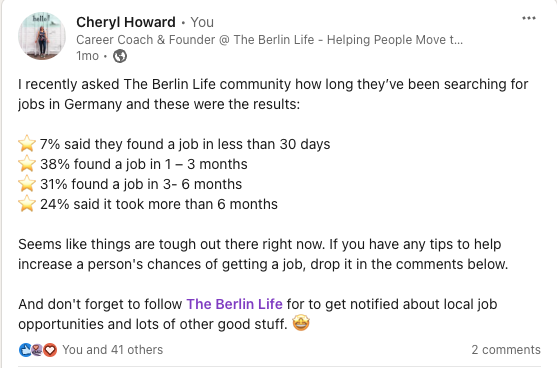
First, there’s the job hunt itself. It’s not likely you’ll find your dream job overnight. Berlin’s a tough place to find work, and it could take several weeks, even months (yes!), before you find a job that suits your education, experience, personality, and skills. In March 2024, I asked The Berlin Life community how long it took them to find work in Germany.
Be part of something bigger: Connect with The Berlin Life community on Slack and Facebook. You can also follow us on LinkedIn for regular job postings, start-up funding news, and other updates.
As you can see from this (very anecdotal) example, some people found a job rather quickly, but others had their work cut out for them.
The stories of people who find jobs in less than two weeks aren’t just urban legends – it does happen this way for some people. Some even submit cold applications to a company or meet an influential person at a networking event and end up having a job position created for them. Good things can and do happen for some fortunate individuals, and those accomplishments should be celebrated! 🥳
Sadly, these events are rare and not the norm. For most respondents, it took them anywhere from one to six months to find a job. There’s a reason I have this business and can do well: people need help finding a job in Berlin!
Let me share some of my more recent job search experiences:
When the pandemic hit in 2020, my company entered the Kurzarbeit program (read an overview about how the program works). While the government assistance was welcomed, my hours and pay were significantly reduced. After several months, the situation was no longer financially tolerable, and I started looking for work. It took me about six months to find something, and while I didn’t submit job applications every day, I applied to many jobs during that time. In some cases, I got immediate rejections, and in other cases, I went pretty far in the recruitment process and was still rejected. This was after completing countless interviews, taking tests, doing case studies, and running day-long workshops. It was a time filled with many highs and lows, and sometimes, I lost faith in myself. It’s hard not to take rejections personally. Ultimately, I received two offers, accepted one, and started a new job in December 2020.
Fast forward to March 2023, when my employer began to experience financial difficulties, and layoffs were on the horizon. This time around, it took me no time at all to find a job. I suppose it was because I’d become a job application and interview whiz after coaching many others. I applied to eight companies and received two offers in less than two months. 💪
Then, you wait for your visa to be approved. Note: This section only applies to those from outside the EU who don’t have permanent residence or citizenship. Skip ahead to point two if this isn’t relevant to you.
As a non-EU citizen, you can’t simply start a new job even once you’ve signed a contract with an employer. You must submit a visa application and wait for it to be approved. Visa waiting and processing times in Berlin vary—they can sometimes happen in a few weeks, and in more exceptional cases, they can take months. Complications may slow things down, too, like a backlog at your home country’s embassy or extensive investigations into your academic credentials on the German side.
My visa was once rejected because the ZAB didn’t recognize my business degree. They requested I return to them with additional information, and the back-and-forth process delayed my visa approval by an extra month. By this time, I’d been living in Germany for about three years, and oddly, my degree hadn’t been questioned with any previous visa applications. It shows that you can never anticipate how the visa process will go!
While your visa approval is pending, you’re not permitted to work, and there’s also no guarantee that your visa application will be approved. All you can do is hang in there and wait for everything to fall into place. I know that for myself and for others who’ve moved here, this waiting process can be angst-ridden, and it can be challenging to remain positive. The situation is entirely out of your control, and accepting this is a tough pill to swallow. While it’s hard to endure the wait, do know that almost all visas do get approved. Take it from someone who knows – I’ve gone through it on five separate occasions!
There is also really good news. Germany desperately needs skilled workers. In March 2024, German Economy and Climate Minister Robert Habeck said, “Germany’s shortage of workers is the biggest risk to growth.” At the time of writing, there were more than 700,000 vacancies in the German labor market. As the German population continues to age (more people are dying than having babies!), this number will only grow, and they will need skilled workers from abroad more than ever. The government recognizes the urgency and is taking all sorts of action to make it easier for us foreigners to come here, be it the new opportunity card, enabling dual citizenship, and relaxing Blue Card requirements. What’s more, almost 70 percent of new jobs were filled by foreign workers in 2022.
Recommended reading: If you’re wondering what jobs are in demand here in Germany, check out our list. You can also use Make It In Germany’s quick check to find out about your chances of finding work.
All in all, while it’s essential to remain realistic and persevere throughout your job search and/or visa application process, there are very positive signals emerging for foreigners seeking to work in Germany.
2) Learn German
Do you need to know German to find a job in Berlin? Honestly, the answer to this question is not as straightforward as you might think. While a growing number of companies in Germany operate purely in English or are at least offering some positions in English, we’re still in a moment where an even bigger number of companies don’t communicate in English (or any other language) in the workplace. There are also certain professions that demand fluent German, like most positions in healthcare or law for example.
Stats from 2019 show that at least 93% of the jobs available require German language skills. While that number is dated and has gotten lower since then, it still supports the fact that the vast majority of jobs in the market cannot be filled by anyone who doesn’t possess some level of German fluency. I see a lot of people complaining about this, and I’m always … shocked!? German is the country’s official language. While things are starting to change for the better as more people from around the globe move to Germany, change will take time, and we can expect it to be this way for a while. It’s your choice whether or not you want to take up German (no judgment here!), but if you do really want to succeed at finding a job in Berlin, learning German is key.
Recommended reading: Find out why it’s so important to learn German when you live in Berlin and this other post, which dives more deeply into the situation with English-speaking jobs in Berlin. We also feature a list of German language schools in Berlin.
Don’t fret, though. It’s possible to find English-speaking jobs in Berlin, but not speaking German really narrows down your pool of potential job opportunities. Just think about it: the more German you learn, the better your chances of finding employment are and the more opportunities you’ll have. You’ll set yourself apart from others if you can communicate with potential employers in their language. And remember, it’s not only foreigners applying for the limited number of available English-speaking jobs but Germans who can speak English too.
So learn German, folks! 😉
Follow these pro tips to learn German in Berlin:
1) Enroll in a language class long before moving to Berlin. If that’s not possible, enroll as soon as you get here. If your company offers a class, take advantage. Make it a priority to learn as much German as possible and be as fluent as possible. Use online language learning resources like Rosetta Stone, Duolingo, and Lingoda to accelerate your class learning.
2) Indicate your level of German proficiency on your CV and be sure to display it prominently so recruiters can assess whether or not your level is what they require for the job position. Make sure to specify the level of German that you know, like A1, B2, etc., versus writing that you’re “good” at speaking German. No one will know what the latter means as it’s not objectively qualified, but employers will have an idea about your proficiency if you say A1.
3) Job descriptions written in German generally imply that native German fluency is required, but if you like the position, go ahead and apply anyway. Take the chance, as the employer may like you and decide to hire you despite your lack of language skills. Just be honest from the start, sharing your level of German on your CV and with the recruiter or hiring manager during the first call.
The bottom line is that being fluent in German will make your job search easier and ensure you have a higher chance of finding work in Berlin and, more importantly, improve your overall quality of life here.
3) Have Savings
How much money should you have in the bank while waiting to find a job in Berlin? Maybe you’re rich. Perhaps you’re generously supported by family, like your parents or a spouse. Maybe you’re like me – I moved to Berlin alone and without anyone to support me financially. As this was and is my situation, it’s always been imperative that I have a solid financial foundation.
Due to the length of time it could take you to find a job in Berlin and/or wait for your working visa to be approved, I’d highly recommend that you have enough savings to live off of until you’re able to find work. I came with enough to survive comfortably for six months and would suggest the same for everyone else.
I know that’s a lot of money. Most of us probably don’t have that much cash on hand. If you don’t have six months in savings, look into getting access to an emergency credit card or line of credit as a backup plan. Perhaps ask a friend or family member if they can support you with a loan should you find yourself in a tight spot.
How much you need to survive in Berlin without a job is entirely up to you. It all depends on your lifestyle. i.e., Living in a shared WG versus living alone, living in a famous district versus living outside the Ringbahn, eating out a lot over cooking at home.
Recommended reading: To get an idea of the cost of living in Berlin, check out my post on the topic. I share a detailed breakdown of my monthly expenses and I also suggest reading this post to figure out how much it will cost you to move to Germany.
Stay on top of your finances while you’re unemployed. Make sure that you don’t burn through all of your savings just trying to find a job. Monitor your budget carefully to know when you’ll come to that point where you may need to rethink whether staying in Berlin makes sense. If you come to a point where money is running out, you’ll need to seriously consider your options. Make sure you have enough money left to support a move back home or somewhere else. You may need money to buy a plane ticket, ship your belongings, pay off final bills, and more.
It’s also essential to keep a financial buffer even after you’ve found a job in Berlin. You’ll be on probation for the first six months of your employment and during this time, your employer can terminate you on short notice, only having to pay you for two weeks of work. In more extreme cases, some companies in Berlin (most notably startups), are notorious for letting you go quite suddenly and even not being able to pay salary, as they go about restructuring and/or shutting down their businesses. This happened to me! I once worked at a startup and decided to leave when the company failed to keep up with one of its most basic legal obligations and ethical responsibilities – paying us on time, if at all. When they did, it sometimes even appeared in “installments.” It put me in a relatively precarious financial situation. It was a humiliating and stressful time for me as I burned through my savings, borrowing money from friends, and even hustling some freelance writing work just to get by.
So take it from someone who learned the hard way: don’t overlook the importance of money in the bank.
4) Work Your Way Up
Get your foot in the door with an entry-level position. How else can you find a job in Berlin? As you may not find that perfect job right away, one option is to take on an entry-level position. Take a job as an intern, excel at it, and show your new employer why they should hire you as a permanent employee, hopefully awarding you a promotion and of course, a pay raise. Or take a job as a junior in a field in which you’re interested in gaining more experience, such as AI or data analysis. This tip is obviously more suited to recent graduates than seasoned professionals, but it could be a great starting point for someone without a lot of experience.
Be careful of dysfunctional workplaces and exploitative employers. Unfortunately, the intern culture in Berlin has a bad reputationand can be quite exploitive. Be sure not to take a job without signing a contract, doesn’t pay industry standards and/or requires you to work overtime without appropriate compensation. Although Germany has a minimum wage (currently at €12 per hour), some companies continue to exploit young talent.
5) Be Someone With Multiple Side Hustles
Take on multiple gigs and do a little bit of this and a little bit of that. Embody the true Berliner spirit and hold several jobs at one time. Bartend at night, work at a coffee shop during the day, DJ on weekends, and walk dogs whenever you have a spare moment. Offer services as a photographer, website designer, you name it. Work temporarily for food delivery services like Uber Eats or Wolt. Whatever it takes!
When I’ve been tight on cash, I’ve done things like sell backlinks on my blog, ghostwrite for sex sites (that was actually fun!), and even transcription work. Find ways to make money while you’re looking for more serious work and you never know, perhaps one of those gigs could lead to something more substantial. I know an accountant from the US who started doing tax returns for Americans in Berlin and turned that into a full-time job and a thriving business.
A word of warning. It’s important to acknowledge that this option doesn’t apply to people who don’t have a visa that gives them permission to work in Germany. If you hold a tourist visa or a job search visa, for example, you’re not permitted to work. What’s more, working “under the table” is highly illegal, and you, and the person who hired you, could face serious legal and financial consequences, and even deportation.
It’s a tough time out there in the world right now and it’s perfectly understandable if you take on paying work when you shouldn’t. If you decide to do so knowing the risks, be careful and take care. i.e. You may not be covered by insurance if you get hurt on the job.
6) Apply At Startups
Startups offer promise and opportunity. Startups are one of the best ways to find a job in Berlin – especially if you’re a beginner at the German language. Generally, startups are more open to hiring foreigners than traditional German companies. It’s becoming more normal that they intentionally seek and hire talent from all around the world, relocating people to Berlin just to work for them. Scoring work at a startup is an exciting opportunity to help build a brand-new company from the ground up and usually offers a challenging, fun working environment with international teams. Startups come with other less important perks like regular parties, Friday evening socials with free booze, and other things like gym memberships, free transit passes, and more. The social aspect is especially appealing, and I’ve made some of my best friends through work!
However, working at Berlin startups involves taking on a certain level of risk. Don’t decide to take a job at a startup lightly, as data shows that 75% of all German startups fail within their first year. While the promise of working at a young company may seem promising, there are unfortunate and common realities with many Berlin startups. Startup jobs tend to pay less than the industry average, the company may be run by inexperienced founders, and involve a toxic work environment where bullies thrive, and overwork is encouraged. The biggest issue of all is that it’s not uncommon for companies to close their doors or go through regular downsizing exercises. As mentioned, I worked for a place that went out of business and lost my job twice due to company-wide layoffs – all within my first few years of living in Berlin! 😱
Do your research before signing on with a startup. As startups are more prone to financial woes than larger companies, be sure to research them in advance and apply to the ones that have solid financial backing, are (or soon will be) generating revenue, show a track record of a successful business strategy, and/or have signed up big-name clients. Look to apply for jobs at scale-ups that are more mature, around 3 – 5 years old, vs. ones that opened their doors within the past 6 months – 1 year.
I’d also recommend looking on websites like Glassdoor or Wellfound to see reviews from people who’ve worked for those companies. Google the company name and check out recent news articles about them. Are they unethical like N26, trying to quell their staff’s effort to form a work council? Has the company secured a massive round of funding like Blacklane? By doing this research, you can make an informed decision about whether or not you want to apply for a job there, take an interview, or accept an offer.
Recommended reading: This guide about how to research companies in Germany.
One way to stay on top of funding news and startup developments in Europe is to follow Sifted and tech.eu. You can also get all sorts of juicy data on German startups from Statista.
7) Use All Of The Job Search Websites
Use the right job search websites to find a job in Berlin. There are so many job search boards out there dedicated to working in Berlin, it’s really hard to know where to get started. Frankly, it’s overwhelming. Lucky for you, I got you covered – read my guide with the best Berlin job search sites. Although there are an overwhelming number of job search sites out there, choose a handful that are relevant for you. I’ve found most of my jobs by only using LinkedIn. Some people say using Germany’s version of LinkedIn, Xing, is another good option. Scan the sites regularly (actually religiously) for fresh opportunities – I’d advise looking daily if you’re really serious about finding a new job. Subscribe to alerts or mailing lists to be made aware of new postings that may suit you and be one of the first to apply.
Google makes everything easier. A simple hack to find a job in Berlin? Use Google to your advantage – for example, if you’re an agile coach like me, simply Google – “agile coach jobs in Berlin” to view related postings. You can also refine your search by adding a language filter – Google “agile coach jobs in Berlin English” to see if there are any opportunities available in your spoken language.
Apply directly through company websites. Another way to find a job in Berlin is to apply directly through company websites. It’s actually not uncommon for companies to avoid using external job sites to advertise their jobs. Do you research, identify companies where you want to work, and check out their career pages. If you see something that looks like a good fit, submit your job application immediately – don’t wait. The sooner you can apply for a job the better, as people who apply for jobs while they’re still fresh may have a better chance of getting hired.
To get you started, I suggest reading my list of companies in Berlin that are hiring right now.
8) Be A Freelancer or Start Your Own Business
Go out on your own and be an independent freelancer. It’s fairly straightforward to get a freelancing visa in Germany if you can prove you have a steady income and meet other various requirements. This kind of visa can be especially ideal for those who desire to have a flexible schedule and be self-employed. I have a number of friends in Berlin who work as writers, graphic designers, tour guides, software developers, etc., and all make a living from existing contracts in their home country, here in Germany, and/or elsewhere. My former boss now works as a freelance agile coach, so he can spend more time with his family and pursue his passion for theater.
After my first working holiday visa expired back in 2012, I applied for a freelancing visa which allowed me to work as a travel writer and a project manager. I made money writing content for a Berlin hotel, through my blog and doing project management consulting for a local med-tech company. It was such a fun time! One day, I’d be out on assignment attending a Berlin fashion week show for the hotel, another day I’d be jetting off on an all-expense paid trip to Italy, and other days, I’d be hacking it out as a regular employee at office.
Launch your very own enterprise. Another way to find work in Berlin is to start your own business in Berlin. You can open a business to help other Berlin newbies and be a career coach or a relocation consultant. You can open your own restaurant. You can sell your art on Etsy and at markets around Berlin. There is so much potential to be had if starting your own business is something you you wish to do.
Of course, it won’t be easy, but it will be worthwhile. Being an independent freelancer or a business owner is no easy feat. There will be a lot of blood, sweat, and tears. Fortunately, there is a lot of help out there, like Berlin Partner, an economic development agency for the state of Berlin. There are also plenty of support groups on Facebook, like Berlin Boss Babes (for women only) or the Berlin Creatives Network.
9) Get The Right Visa
What are some visa options for foreigners planning to move to Berlin and find work?
If you don’t want to be a freelancer or a business owner, getting the right visa will determine how long you can stay in Germany and whether you can work. Note: If you’re already a citizen of Germany or the EU, skip this part as it doesn’t apply, and move on to the next point on this list.
Some of the visa options for non-Europeans include:
1) The tourist visa: Depending on where you’re from, you can come to Germany and stay for up to three months as a tourist. While you cannot work during this time, you can search for a job, get to know Berlin, and even learn German.
2) The job seeker visa: This visa is great for those who don’t have a job yet, as the job seeker visa grants temporary residency to qualified professionals and recent graduates from German universities with relevant post-secondary degrees or vocational training. The permit will be granted anywhere from 6 – 18 months, depending on your circumstances. While you hold this visa, you cannot work, but you can search for work except for trial purposes. As with most visas, you’ll need to prove you have money in the bank, health insurance, and related education recognized by the Central Office for Foreign Education (ZAB) or training. Read more at berlin.de.
3) Working holiday visa: Also called the youth mobility visa, citizens from Australia, Canada, New Zealand, Japan, Taiwan, and Hong Kong can apply for a visa to stay in Germany for up to one year to study or work. Approval of these visas requires you to show that you have a certain amount of money in your account and health insurance, among other things. Unfortunately, these working holiday visas are unavailable to Americans or “old people”, anyone over 35. Read more at berlin.de.
4) Regular work visa: If a company in Berlin has given you a job offer, you can apply for a regular work permit. Most companies will help you through this process – check out this step-by-step guide to the German visa process, which explains what the company must do versus what you need to do. This will permit you to live in Germany and work only for the listed company and the position specified. You may need to apply for a new visa if you lose your job. These visas tend to expire after two or three years as well. Read more at berlin.de.
5) Blue Card – Certain qualified professionals can apply for a Blue Card, another type of work permit focused on skilled workers (i.e., software engineers) earning more than €45,300 annually (gross). Exceptions are made for those working for a profession with a labor shortage, and then you only need to earn €41,042 annually. Most companies will help you through this process as well. Blue cards are the gold standard for visas in Germany, as the path to permanent residency is easier and shorter. You can apply for permanent residency after 21 consecutive months of employment and knowledge of elementary German (A1 level). Blue cards typically last around four years. Read more at berlin.de.
6) Residence Permit (For Spouses and Children) – This visa is available to people from outside the EU who are married to a German or EU citizen and/or have a child with a German or EU citizen. Read more at berlin.de.
Some other important items to note regarding German visas?
1) If you come to Germany and search for work while on a tourist or job seeker visa and then get hired for a permanent position, you’ll have to apply for an entirely new visa before you begin working at the company.
2) Some people think you can work with a job seeker visa. This is false – you’re legally prohibited from working with this visa. A minor exception is that you can work a maximum of 10 hours a week for evaluation purposes with a prospective employer. For example, when I applied for my last job, I had to do a trial day, which lasted six hours and involved a couple of hours of prep work the day before.
3) Getting a visa in Germany is easier for some than others and depends on where you’re from, so be sure to check out the specific requirements for your country. I’d also recommend researching your visa requirements extensively, so you know what you need to do and will succeed in getting your visa approved on the first try. Check on official government websites and/or hire an immigration lawyer or relocation company to help you. Don’t rely on what people tell you in Facebook groups or by watching someone a content creator’s videos. While people may have good intentions, their information is often incorrect – especially these days, when immigration laws are changing so frequently. Sometimes, even your employer’s HR staff are unfamiliar with visa laws, so the more you know yourself, the better off you are.
4) Stay on top of your company’s HR department. If they submit the visa application on your behalf, make sure that it’s been submitted, ask for updates often, and don’t be afraid to challenge them if they are unresponsive or slow. Of course, be professional and courteous, but I’ve had friends who showed up for their first day of work only to find out that their visa hadn’t been approved yet and, in another case, not even submitted! This happened because their employer’s HR team messed mishandled their case.
10) Format Your Cover Letter & CV Correctly
Don’t assume that employment customs in Germany are the same as where you’re from. Another tip to finding a job in Berlin is to be aware that local employment customs in Germany may differ from how things work in your home country. This is especially important regarding your cover letter or CV, especially if you want to stand apart from other candidates.
Cover letters in Germany, and do you even need one?
Many people wonder whether cover letters are even needed in Germany. Doesn’t a person’s CV already tell their story? While this is true, cover letters are still essential. Cover letters should never be a cut-and-paste job filled with generic jargon. These letters should always be personal. They give you a chance to tell a company why you want to work for them and how you’re uniquely qualified. They’re a chance to get the employer interested in you right away.
German cover letter tips and tricks.
Now that you know cover letters are essential to your job application package, where do you start? How can you write an impressive cover letter that will immediately grab the attention of your potential new Berlin employer? Several things are musts for a German cover letter – keeping it short and to the point, personalizing it, ensuring it’s addressed to the contact person listed in the job advertisement, and more.
Read our cover letter guides to get started:
⭐ A Definitive Guide On How To Write A German Cover Letter
⭐ Don’t Make These German Cover Letter Mistakes
What about creating the right CV for the German job market?
Germans tend to include personal information on their CVs that isn’t typically included on CVs in other countries. Many people include a professional-looking photo, date of birth, and place of birth. Some people even specify their marital status and whether they have children!
In recent years, I haven’t included my date or place of birth to reduce the bias a potential employer could have against me based on that information. I’ve never once included my marital status. I haven’t found this has hindered me from getting job interviews with German companies.
I advise you to include this information at your discretion due to possible bias based on gender, ethnicity, age, and more. It may make more sense to do so if you’re applying at a more traditional German company, like a big corporation or law firm, as they may expect this data. If you’re applying at a startup and for a job advertised in English, you likely don’t need to include this personal information, as startups tend to be way more informal.
The German job market is definitely different in certain aspects. It’s ultimately up to you to follow some of their employment practices. Some of these employment practices may seem unnecessarily formal to someone from outside of Germany, but not doing this could make you appear unprofessional and even rude in their eyes. Again, alter your approach depending on the job or company you’re applying to and what makes you feel comfortable.
Read our CV guides to get started with applying for jobs in Germany:
⭐ How To Write A German CV To Get Noticed By Employers
⭐ Avoid Making These German CV Mistakes
⭐ Why German CV Photos Aren’t Necessary
Brush up on Germany’s cultural norms to ensure that both your CV and cover letter are updated to reflect their preferred formats.
11) Build A Network And Use It
Networking is essential if you want to find a job in Berlin. Many job openings are never publicly advertised and your friends can alert you to new job opportunities that you’d have never known about otherwise. Not to mention, a personal referral will give you an edge over other candidates applying for that same job – as they tend to be weighted more highly than cold applications and it’s not unlikely, you’ll be guaranteed an interbiew.
So how do you meet people in Berlin? My post about making friends in Berlin highlights some of the methods I used to meet other Berliners from far and wide.
Berlin has a terrific tight-knit community of newbies who offer support to each other, often helping each other find work. When I first moved to Berlin, I really wanted to meet other people. Through following conversations on Twitter, I became aware of a fun “Hamburger Tour of Berlin” event. As funny as it sounds, this actually happened and a bunch of people came together to try out different hamburger joints around the city. It was at one of these events that I met someone who eventually hired me as a project manager and later on at another company, as a scrum master.
Some of my top ways to build a network in Berlin:
1) Create or use your existing social profiles – At the minimum, have a LinkedIn profile. Use it to connect with local Berliners in the same field or area of expertise. Join related groups on LinkedIn and jump in on discussions. Be sure to share your related projects and accomplishments if relevant. X can also be another great place to tap into the local community and build connections. Join Facebook groups, filled with other Berliners looking for jobs and connect with more people there.
Follow me on X and follow The Berlin Life on LinkedIn.
2) Attend professional meetups – Berlin has what seems like a gazillion meetups for anything you can think of, especially from a professional development standpoint and more specifically, tech. There are meetups for agile coaches, front-end developers, lovers of Ruby, product management, and more. Join the related groups and start attending their events. During the pandemic, many of these groups have kept up their meetings through online events. We recommend checking out our list, Build Your Network With These Berlin Startup Meetups.
3) Tell people you’re looking – Share this on social media, with friends and family, etc. Say it loud and proud! Turn on the “looking for work” banner on LinkedIn. You never know who may be aware of an open position somewhere or knows someone in Berlin they can connect you with to start a conversation. There have been times I lost my job due to being laid off and sharing this on Twitter really helped. A lot of people retweeted my post and it got me in touch with several companies. Other people referred me to their companies and I landed not only job interviews but job offers. There’s truly a wonderful community of people out there willing to help.
4) Join our LinkedIn connection list – The Berlin Life has a database where you can add your information and start connecting with other Berliners on LinkedIn long before you even move here.
12) Be Here Physically
If you’re already in Berlin, your chances of being contacted are much higher. Sometimes, it’s as simple as being here. This is becoming less of a factor nowadays, but some companies might not take you too seriously if they see you live abroad. Unfortunately, they may not have the time or budget for international hires. Your chances of scoring a job in Berlin are far better if you show a local address and phone number on your CV and can be available for in-person interviews.
Many companies are recruiting internationally. That said, don’t feel discouraged from applying for jobs even though you’re not in Berlin yet. Be sure to indicate your seriousness about living and working here in your job application and demonstrate your commitment by learning German. An increasing number of companies are open to hiring people from outside Germany and if you’re an attractive candidate, you won’t be excluded during the recruiting process.
13) Use A Relocation Company
How can a relocation company help me move to Berlin and find a job? Relocation companies can help you navigate visa processes, advise on job opportunities, find a flat, and more. You can trust them as experts capable of making pretty much everything about moving to Berlin easier for you.
Relocation companies offer different packages and an array of services, and of course, they usually come with a big price tag attached. We know not everyone has this kind of money (which is why we offer content like this for free), but it may well be worth the investment.
Read our guide featuring the top relocation companies in Berlin.
14) Apply For Companies Outside Of Berlin
If you have a job that can be done remotely, you can actually expand your job search to all of Germany. You can easily work for a company based in Frankfurt, Hamburg, or Munich while living your dream life in Berlin, taking occasional trips for big meetings or team events. Expanding your job search to companies outside of Berlin only widens your pool of potential employment opportunities. Frankfurt has a lot of finance roles, for example, while Southern Germany has plenty of jobs relating to the automobile sector or at research facilities. So, as you continue your search, don’t hesitate to apply for positions in other German cities.
15) Send Out Unsolicited Job Applications
Many companies don’t advertise their open roles publicly, and others explicitly state they welcome unsolicited job applications. This means you can send a CV and cover letter to companies you really want to work for, even if they don’t have any open roles that currently match your profile. As it’s common for German companies to receive these types of applications, many people have been able to find jobs this way. While it takes some skill to retool your cover letter and CV for such applications, sending out unsolicited job applications is definitely something you can do to increase your chances of finding a job in Germany.
Read our guide to unsolicited job applications in Germany to learn more.
Follow these tips to increase your chances of finding a job in Berlin. If we’re missing something vital, tell us about it in the comments so our community can learn from your experiences too.
RELATED CONTENT
What Are The Best Berlin Job Search Websites?
Many people feel overwhelmed knowing where to search for jobs in Berlin. Bookmark our best Berlin job search websites list to get started.

Find a Job in Germany With Our Job Search Checklist
Are you looking for a job in Germany? Use our detailed (and FREE!) checklist to figure out how to find work in Deutschland.

Avoiding Embarrassing German Interview Mistakes: Dos and Don’ts
Discover the most common German interview mistakes and learn the dos and don’ts to help you avoid embarrassing slip-ups.

Cheryl Howard, Founder @ The Berlin Life
Hi, I’m Cheryl. My mission is to help you move to Berlin and find work.
A Canadian in Berlin for 10+ years, I have the unique experience of moving to Berlin – not once, but twice. During my time in Berlin, I’ve had five different visas and worked as both a freelancer and a permanent employee for numerous Berlin companies. I even managed to find a new job during the pandemic and again in 2023, during Germany’s recession and massive layoffs in tech.
My day job has involved work as a hiring manager, overseeing the recruitment of countless people, as well as a team coach helping teams and individuals work better and find happiness in their careers. Through my side projects, I’ve also shared my personal experiences by publishing a series of helpful blog posts, creating a thriving community of job seekers, and hosting events to help people find work in Berlin. In 2021, I decided to put my coaching and recruiting talents to use by creating The Berlin Life, bringing my existing content and community together in one spot.
The combination of my personal and professional experience means I know exactly what it takes to move to Berlin and find work.
I have always wish to travel to Germany its my dream country but anytime i try my country ask for an ivitation from some one who is living in Germany so it make diffcuite for me to migrate to German ,we really be greafull if some could help me out with this process thanks this article has really help me unstand alot about the important of learning German language .
Hi Ngwa! If you’re looking for advice about how you can come to Germany, I’d recommend getting in touch with Because Berlin. They are a government entity that offers advice for free and in English. Good luck!